For a long time, I thought I was pretty good at reading marketing dashboards. I could tell you which Google Ads campaign had the lowest cost per lead, which landing page converted best, which keywords were gaining traction in organic search, even which email subject line generated the highest open rate.
Every Monday morning there was another graph pointing upward, another metric suggesting things were moving in the right direction.
Then, during a quarterly pipeline review, the Head of Sales said something that completely changed the way I looked at marketing.
He wasn't criticizing the campaigns or questioning the numbers. He simply asked:
"Which of these leads are actually becoming customers?"
It was one of those deceptively simple questions that immediately exposes the difference between measuring activity and measuring outcomes.
We had built a sophisticated system for tracking how people entered the funnel. We knew surprisingly little about what happened after they got there.
Looking back, the problem wasn't that our reporting was wrong. Every dashboard was technically accurate. Google Ads showed conversions. GA4 showed engaged sessions. HubSpot told us how many MQLs we'd generated. Salesforce had a healthy-looking pipeline.
The trouble was that each platform was answering a different question, and almost nobody was looking at all of them together.
Marketing celebrated lower acquisition costs because that's what the marketing dashboard measured. Sales celebrated closed opportunities because that's what the CRM measured.
Everyone was acting rationally within the boundaries of their own dashboard, yet the business still struggled to answer a question that should have been embarrassingly simple:
Which parts of our marketing are actually creating customers, and which parts are merely creating activity?
Start With Revenue, Not Traffic
That question fundamentally changed the way I approach every marketing engagement.
Today, one of the first questions I ask a founder isn't, "What's your ad budget?" or "How much organic traffic are you getting?"
It's much simpler than that.
"Can you show me how someone becomes a customer?"
I don't mean the idealized journey from the sales deck. I mean the real one. Where does the first touch usually happen? How long does it take before someone speaks to Sales? Which pages do prospects repeatedly visit before requesting a demo? How many opportunities stall after technical validation? Where do customers disappear?
Every company has answers to those questions, but they're rarely documented in one place.
They're scattered across Google Ads, Search Console, GA4, HubSpot, Salesforce, Gong recordings, Slack messages, and the accumulated intuition of people who've been with the company for years.
Before I think about improving a campaign, I want to understand how all of those pieces fit together.
Because once you see marketing as a system instead of a collection of channels, your priorities change almost overnight.
Marketing begins by asking how to generate more traffic. Which channels should we invest in? Which keywords should we rank for? How much should we spend on Google Ads?
Founders rarely think that way. They start with a revenue target. They know the business needs another five million dollars in ARR next year, or another hundred enterprise customers, and they work backwards from there.
That's one of the reasons I've stopped planning campaigns in terms of clicks, impressions or even leads. I start with the number the board cares about and force every marketing decision to justify itself against it.
Let's make this concrete. Suppose a SaaS company tells me they need another $2.5 million in Annual Recurring Revenue over the next twelve months.
My first instinct isn't to ask how much we should spend on Google Ads. It's to start building a model.
If the average contract value is $25,000, we need one hundred new customers. If Sales closes one out of every five qualified opportunities, Marketing doesn't need one hundred leads — it needs five hundred genuine sales opportunities.
If only half of Marketing Qualified Leads ever become Sales Qualified Leads, we're now aiming for roughly a thousand MQLs.
If the website converts 2.5% of qualified visitors into MQLs, suddenly the conversation changes again. We don't need "more traffic." We need approximately forty thousand visitors who actually resemble our ideal customer profile.
Every assumption in that model can be challenged — and it should be — but once the numbers are on the table, every marketing decision has context.
Acquisition Is an Amplifier
The value of building a model like this isn't that the numbers will be perfectly accurate. They won't. Close rates fluctuate, average contract values change, markets slow down.
What the model gives you is something much more useful: leverage. It tells you which assumptions matter enough to deserve your attention.
One consequence of planning from revenue backwards is that I've become remarkably slow to launch advertising campaigns.
It's not procrastination. It's because I've learned that Google Ads is an amplifier. It doesn't fix positioning, weak messaging or an unclear offer. It simply helps more people encounter them.
If the business hasn't yet developed a crisp answer to "Why should someone choose us instead of the other five vendors they're evaluating?" then spending another twenty thousand dollars on paid acquisition usually accelerates the wrong outcome.
Only after I've built that context do I log into Google Ads.
More often than not, I head straight to the Search Terms report. I've always thought it was one of the most underappreciated customer research tools in marketing.
Campaign settings tell me what we hoped people would search. Search terms tell me what they actually searched.
The Click Isn't the Hard Part
One mistake I see repeated across B2B SaaS is treating the click as the hard part.
It isn't.
By the time someone arrives on your landing page, several things have already gone right. Google decided your ad was relevant enough to show. The prospect found the headline compelling enough to click. You now have their attention.
The landing page has a much simpler job than marketers often imagine. It doesn't need to sell an enterprise software in sixty seconds. It just needs to answer the next question in the buyer's mind and they'll keep moving.
What friction is this reducing?
If the visitor is wondering whether the software integrates with SAP, the page should answer that. If they're worried about implementation time, show them the implementation process. If security is likely to become a procurement blocker, don't hide your compliance information behind a sales call.
Every unanswered question increases friction and in enterprise software, uncertainty is usually a stronger force than excitement.
When a landing page underperforms, I rarely begin by changing the copy. I begin by watching people use it.
Microsoft Clarity, Hotjar or FullStory have become some of my favorite marketing tools because they expose something analytics platforms never will: hesitation.
A conversion rate tells you what happened. A session recording often tells you why.
The CRM Isn't a Database. It's the Marketing Engine.
One habit I've never understood is the way companies treat the CRM as the place where marketing ends and sales begins.
In practice, the opposite is usually true. The CRM is where marketing finally becomes measurable.
Until someone exists as a record tied to an opportunity, most of what we're looking at are proxies — clicks, sessions, conversions, cost per lead, engagement rates.
Useful proxies, certainly, but still proxies.
The moment a prospect enters the CRM, the conversation changes.
Now we can ask questions that matter to the business. Which campaigns consistently produce opportunities rather than just leads? Which industries move through the pipeline fastest? Do manufacturing companies convert at twice the rate of distributors?
Those aren't advertising questions or SEO questions anymore. They're business questions, and the CRM is one of the few places where marketing finally has enough context to answer them.
Intent Leaves a Trail
One place where this disconnect shows up repeatedly is lead scoring.
On paper, most lead scoring models look perfectly sensible. A Director gets ten points. A VP gets fifteen. Someone from a target account receives another twenty. Download a whitepaper, add five more. Visit the pricing page, add another ten.
Eventually the total crosses an arbitrary threshold and the lead is handed to Sales.
I've implemented systems like this myself, and they certainly create order where none existed before.
But over time I found myself trusting the score less and the behaviour more.
A Procurement Director downloading an industry report is not the same buyer as an Operations Manager who has visited the pricing page three times, read the implementation guide, compared two competitors, forwarded the security documentation to IT, and returned a week later with colleagues from the same company.
Traditional lead scoring often concludes that the first person is more qualified because their title is more impressive. In reality, I'd happily bet on the second becoming a customer.
Intent leaves a trail, and I've found that trail is usually more predictive than demographics alone.
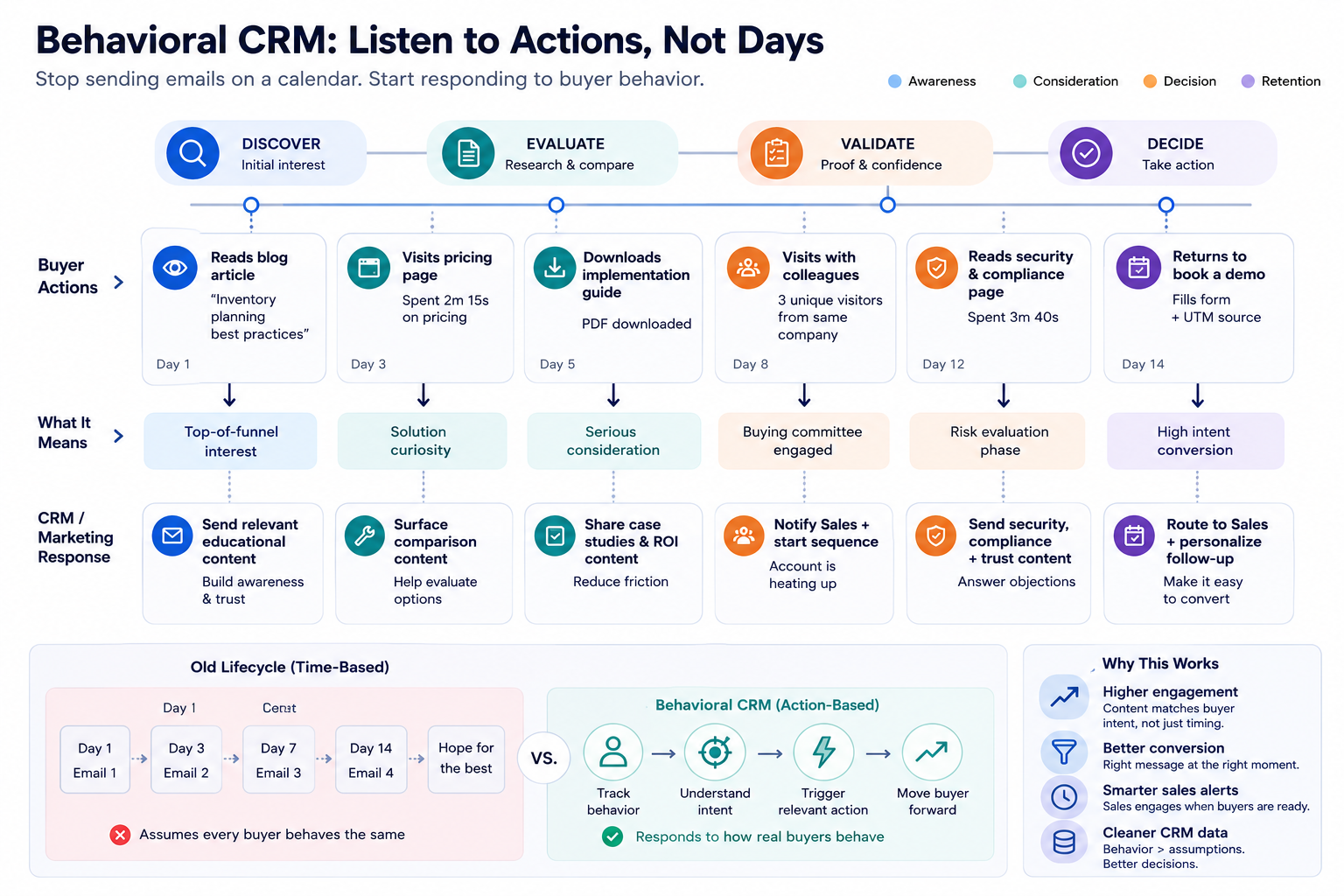
From Time-Based to Behavior-Based Lifecycle
Most modern CRMs capture enough of this behavior to make it actionable, yet many companies reduce it to a single engagement score.
I prefer to think in sequences rather than events.
One visit to a migration guide might not matter. But when it follows three product-page visits, a comparison article, and a pricing page within the same week, it's often a signal that the buying conversation has moved from curiosity to evaluation.
That's the moment I want Sales to know about — not because the lead crossed an arbitrary score of seventy-five, but because their behavior suggests they're trying to answer implementation questions before making a decision.
The same idea completely changed the way I thought about marketing automation.
Early in my career, most nurture sequences I built were based on time. Wait two days, send an email. Wait another five, send a case study. If they haven't responded after two weeks, invite them to a webinar.
There's nothing inherently wrong with that approach, and for low-consideration products it often works well enough.
Enterprise software is different. Buying decisions don't move because three days have passed.
They move because someone inside the buying committee learned something, solved an objection, involved another stakeholder or reached the next stage of internal evaluation.
The trigger isn't the calendar. The trigger is evidence that the customer's thinking has changed.
I'd rather send an implementation guide because someone spent ten minutes reading integration documentation than because it's "Day 7" of a nurture sequence.
I'd rather notify Sales that a prospect has revisited pricing after sharing the security documentation internally than because their lead score crossed eighty points overnight.
Why Most Marketing Dashboards Lie
Every marketing dashboard tells the truth. It just doesn't tell the whole truth.
Google Ads reports clicks, conversions and cost per acquisition because those are the outcomes Google can observe. GA4 reports sessions, engagement and events because that's the world it lives in. HubSpot focuses on contacts and lifecycle stages. Salesforce cares about opportunities, pipeline and revenue.
None of those systems are wrong.
The problem begins when we mistake a local truth for the whole story.
I've been in situations where I reported that cost per lead had fallen by thirty percent while Sales quietly mentioned that close rates had also gone down.
Both teams were telling the truth. Neither team was describing what was actually happening to the business.
The dashboard wasn't lying; it was simply answering a narrower question than the one the company really needed answered.
Attribution Is Broken. Here's What I Trust Instead.
If there's one area of marketing that has made me more humble over the years, it's attribution.
Early in my career I thought the challenge was choosing the right attribution model. First touch, last touch, linear, time decay — every platform had a slightly different philosophy, and every consultant seemed convinced theirs was the most accurate.
I don't think that anymore.
After watching enough buying journeys unfold, I've come to believe that attribution isn't a reporting problem so much as an observation problem.
Modern B2B purchases simply don't happen in a straight line.
A prospect might discover you through a Google search, ignore you for three months, hear your CEO on a podcast, see a LinkedIn post shared by a colleague, read two comparison articles, ask ChatGPT for alternatives, click a retargeting ad, attend a webinar, and finally request a demo after searching for your brand directly.
Every platform involved in that journey will happily claim some portion of the credit. None of them can honestly claim to have witnessed the entire story.
Because of that, I've gradually become less interested in finding the perfect attribution model and more interested in collecting multiple pieces of imperfect evidence.
I'll certainly look at assisted conversions in GA4 and campaign influence reports in HubSpot or Salesforce, but I rarely make important decisions based on those reports alone.
I want to know which pages repeatedly appear in closed-won opportunities, not just which pages generated the first visit.
I'll ask Sales what competitors keep coming up in discovery calls, because changing competitive dynamics often explain performance swings long before dashboards do.
I pay attention to branded search volume because it tells me whether more people are actively looking for us rather than simply discovering us by accident.
I read CRM timelines to understand the order in which prospects consumed information. Sometimes I'll even go back to call recordings simply to hear a customer answer the deceptively simple question, "How did you first hear about us?"
None of those signals is complete on its own, and they occasionally contradict each other.
That's precisely the point.
Attribution becomes much more reliable when you stop treating it like a mathematical equation and start treating it like an investigation.
You're assembling evidence until a pattern becomes difficult to ignore.
Ultimately, the reason I care about attribution has very little to do with reporting. I care because every quarter the business has to decide where the next dollar should go.
Should we hire another content marketer or another account executive? Increase Google Ads by twenty percent or invest in product marketing? Sponsor an industry conference or build a comparison page that Sales has been asking for all year?
Attribution isn't there to satisfy my curiosity about what happened in the past; it's there to improve the next decision.
Marketing Is a System, Not a Collection of Channels
When I look back at the companies where marketing worked exceptionally well, I don't remember them because they had brilliant Google Ads campaigns or because their SEO strategy was ahead of everyone else's.
I remember them because every part of the customer journey reinforced the next.
Search wasn't competing with paid media; it was introducing future buyers to the category.
Paid search wasn't replacing organic traffic; it was capturing demand that already existed.
Product marketing gave Sales better stories to tell.
Customer Success uncovered objections that became landing pages.
Nothing operated in isolation for very long.
The channels weren't successful because each one had been optimized independently.
They became successful because information flowed freely between them.
That's probably why I've become uncomfortable with job descriptions that divide marketing into neat categories.
SEO. PPC. Product Marketing. Lifecycle. Demand Generation. Marketing Operations.
Those specialties absolutely exist, and in larger organizations they should.
But the customer never experiences them separately.
They don't know or care that the comparison page was written by Product Marketing, the Google Ad was managed by the performance team, the onboarding email came from Lifecycle, and the implementation guide was published by Customer Success.
The customer experiences one company.
That's the system I'm interested in building.