If someone hired me tomorrow and said, "Prepare our website for AI search," they might expect me to spend the morning experimenting with prompts or researching the latest GEO framework. I probably wouldn't do any of those things.
Instead, I'd make a coffee, open Google Search Console, and spend the next hour looking at a spreadsheet full of queries that most marketing teams ignore. Not the keywords we're already winning, and not the ones stranded on page seven, but the frustrating middle ground: the pages ranking somewhere between positions eleven and thirty.
Over the years I've found that these pages are usually the most honest part of any website. They tell you that Google already understands what you're trying to say, but isn't yet convinced you're the best person to say it.
Google has crawled them, understood them, associated them with a particular topic, and decided they're relevant enough to appear on the second or third page of results. In other words, the hard work has already been done. The page isn't invisible; it's unconvincing.
That changes the nature of the investigation. I'm not looking for technical errors in the abstract anymore. I'm trying to understand what signal is missing.
Is the page answering the wrong question? Has a competitor explained the implementation more clearly? Does every ranking page include pricing, migration advice or industry-specific examples while ours stops at definitions?
Sometimes the answer is as mundane as weak internal linking. Other times it's because the page was clearly written by marketing when the person who actually understands the problem sits in Product or Customer Success.
Those are very different problems, but they share one characteristic: none of them are solved by sprinkling another keyword across the page.
Your Best SEO Strategy Is Probably Sitting in Your Slack Workspace
A few years ago, I noticed something that completely changed the way I approached content planning.
It didn't happen inside Ahrefs.
Or Semrush.
Or Google Search Console.
It happened during a customer onboarding call.
An implementation consultant spent nearly twenty minutes explaining why a customer's ERP integration had failed. The explanation wasn't particularly polished. It wasn't meant to be. He was simply solving the problem in front of him.
But as I listened, I realized he'd answered more genuinely useful questions in twenty minutes than our blog had managed in the previous three months.
He explained why the integration broke in the first place. He talked about data normalization, mismatched SKUs, purchase approval workflows, and why customers almost always underestimate the effort required to migrate historical purchasing data.
None of those topics had ever appeared in our content calendar. If you'd opened Ahrefs, you probably wouldn't have found enough search volume to justify writing about them either.
And yet those were precisely the questions prospects cared about once they became serious buyers.
That experience made me suspicious of the way most SaaS companies approach keyword research.
Keyword tools are extraordinarily good at measuring existing demand. Give them a phrase like inventory management software or procurement software, and they'll estimate monthly searches, keyword difficulty, click-through rates and a dozen other useful metrics.
I use those tools almost every day, and I wouldn't want to work without them.
They can't tell you that every enterprise prospect asks whether your platform supports delegated purchasing across subsidiaries.
They can't tell you that implementation projects keep stalling because finance teams don't understand how approval hierarchies map into your workflow engine.
Most importantly, they can't tell you which explanation consistently turns skeptical prospects into confident buyers.
That information exists somewhere else.
Usually it's buried inside sales calls, onboarding sessions, support tickets, implementation documents, internal wikis, Slack threads, or the notebook your solutions consultant has been carrying around for the last five years.
In almost every SaaS company I've worked with, the marketing team spends a surprising amount of time searching for ideas while sitting a few desks away from the people creating them every single day.
That's one of the reasons I think AI search is going to reward companies with strong internal knowledge cultures.
Stop Treating Your Company's Knowledge as Someone Else's Job
One exercise I've started doing with almost every SaaS company is surprisingly low-tech.
I'll ask the Head of Sales for recordings of recent demos, the Customer Success team for onboarding sessions, Support for the fifty most common tickets from the last quarter, and Product for release notes that never made it outside the company.
Then I sit down, not with a keyword tool, but with a notebook and start listening. After a while, patterns begin to emerge that no SEO platform could possibly discover.
You notice that prospects don't actually ask, "Does your software integrate with SAP?"
They ask, "How painful is this integration going to be?"
They don't ask whether the platform supports role-based permissions. They ask whether Finance can approve purchases without slowing down Operations.
Those distinctions matter because they're the difference between features and anxieties.
Keyword tools are excellent at surfacing what people type into search boxes. They are far less useful at uncovering what people are genuinely worried about.
And in my experience, the latter is almost always where the best content comes from.
The reason this knowledge rarely becomes content isn't that companies don't value it. It's that nobody owns the job of extracting it.
Engineers are measured on shipping features, not explaining them. Customer Success is measured on renewals, not documenting onboarding lessons. Sales is trying to close the quarter, not writing comparison guides.
Product teams are thinking about the next release, not the search queries it might answer six months from now.
Marketing sits in the middle of all of this, surrounded by expertise, yet strangely disconnected from it.
So when the quarterly content planning meeting arrives, the team does what almost every team does: they open Ahrefs, sort by search volume, brainstorm a few blog ideas, and inadvertently ignore the richest source of knowledge in the company.
I've come to think of this as an organizational problem far more than an SEO problem.
The companies that consistently build authoritative websites aren't necessarily better writers. They're better at moving knowledge from people's heads into public assets before it disappears into another Zoom call or Slack thread.
The Website Is Becoming a Public Knowledge Base
One consequence of this shift is that I think the boundary between a company's website and its internal knowledge base is going to become much thinner over the next few years.
Traditionally, we've treated documentation, help centers, release notes, API references and implementation guides as support assets.
Marketing lived over here with blog posts and landing pages.
Support lived somewhere else with troubleshooting articles.
Engineering maintained developer documentation that almost nobody outside the product team ever thought about.
I suspect that's becoming an expensive way to organize knowledge.
When I look at companies like Stripe, Cloudflare or Atlassian, I don't see three separate publishing strategies.
I see one continuously expanding body of knowledge that's simply presented differently depending on who's reading it.
The same engineering team that writes documentation is quietly creating some of the company's strongest SEO assets.
The same implementation guide that reduces support tickets also becomes the page an AI model cites when someone asks a technical question.
Even Google's crawler doesn't really care which department published a page.
It sees URLs, internal links, topical relationships and user satisfaction.
The organizational chart that exists inside your company disappears the moment your website is crawled.
All that remains is the quality and completeness of the knowledge you've chosen to make public.
That realization has changed the way I evaluate content opportunities.
A few years ago, if someone had asked me where the next fifty SEO pages should come from, I probably would have opened Ahrefs and started clustering keywords.
Today, I'd begin somewhere completely different.
I'd ask the implementation team to show me the onboarding checklist they use for enterprise customers.
I'd ask Sales Engineering for the document they send prospects after technical discovery calls.
I'd ask Customer Success which questions they answer so frequently that they've memorized the response.
Those documents already contain the structure of excellent content because they weren't written to attract traffic; they were written to solve expensive problems.
That's why some of the highest-performing pages on mature SaaS websites are implementation guides, migration playbooks and integration documentation that nobody originally thought of as "content marketing."
They were simply useful enough that the rest of the internet kept finding reasons to reference them.
SEO Starts Looking Like Product Research
Once I've formed a hypothesis, I stop looking at my own website and start studying everyone else's.
This is the step I think many SEO teams rush through.
They'll compare word counts, check Domain Authority, glance at a few backlinks and move on.
I spend most of my time trying to understand why Google seems happier recommending someone else.
If I'm auditing a page about inventory planning, for example, I'll open the five or six results above mine side by side.
One competitor might include screenshots of an actual forecasting dashboard instead of stock illustrations.
Another may explain the difference between inventory planning and demand planning.
A third might include a section on ERP integrations because they've learned, probably through sales calls, that implementation anxiety is often a bigger buying barrier than feature comparison.
None of these pages win because they're longer.
They win because they leave fewer unanswered questions behind.
That's a subtle difference, but after enough audits you begin to notice that Google's best-performing pages rarely feel like they've been optimized for search.
They are just answering questions.
This is usually the point where SEO stops looking like marketing and starts looking a lot like product research.
I'll have the Search Console open on one monitor, half a dozen competing pages on the other, and a notebook full of questions that none of the tools can answer for me.
Why did three competitors dedicate an entire section to implementation timelines?
Why is everyone comparing this product to spreadsheets instead of another SaaS platform?
Why do two pages keep mentioning purchase approvals when our article barely acknowledges them?
Keyword tools won't tell you any of that.
They can tell you what people searched, but they can't explain the conversations that shaped the pages currently ranking above you.
That's where experience begins to matter.
After enough time sitting in sales demos, customer onboarding calls and product meetings, you start recognizing patterns that never appear in an SEO report.
You realize that buyers rarely search for software because they want software.
They search because they're trying to solve a problem, get something done, or to reduce risk.
Once you see search through that lens, the page you're writing changes completely.
You're no longer trying to satisfy an algorithm. You're trying to remove enough uncertainty that both Google and the buyer arrive at the same conclusion: this company understands the problem better than everyone else.
You may not be the best solution they are looking for — that's a different subject — but simply understanding and explaining those problems will push you in front of the line, whether it's Google or AI.
Internal Linking Is Knowledge Architecture
One consequence of thinking this way is that you stop seeing internal linking as a technical exercise.
For years, SEO has treated internal links as a mechanism for distributing PageRank, and while that's certainly part of the story, I don't think it's the most interesting part anymore.
Internal links are how a company communicates its own understanding of a subject.
Every time you link a beginner's guide to an implementation guide, or a product page to a migration checklist, you're creating a path that mirrors how customers — and now AIs — naturally learn.
Every time you fail to make those connections, you're forcing both users and search engines to guess what comes next.
I see this constantly on SaaS websites.
Marketing publishes an excellent article explaining a business problem, Product has written detailed documentation explaining how to solve it, Customer Success has created an onboarding guide answering the exact questions prospects worry about, and none of those resources acknowledge that the others exist.
The knowledge is there, but it's fragmented across teams that never planned for someone to discover it end-to-end.
That's one of the reasons I spend as much time looking at crawl visualizations in Screaming Frog as I do keyword reports.
A crawl diagram isn't just a map of URLs; it's often a map of how knowledge flows through an organization.
The strongest websites rarely have the most pages.
They have the clearest path.
You're No Longer Trying to Rank a Page. You're Trying to Become a Source.
This is also why I think a lot of the current advice around GEO misses the point.
It assumes AI systems are looking for a new kind of content, when in reality they're looking for the same thing Google has been trying to identify for years: the source that leaves the fewest important questions unanswered.
Think about what happens when someone asks ChatGPT, "Should a mid-sized manufacturer choose NetSuite or Microsoft Dynamics?"
The model isn't retrieving a single article and quoting it verbatim.
It's synthesizing dozens of explanations, comparisons, implementation guides, analyst reports, customer discussions and vendor documentation into one coherent answer.
If your website only contains polished product pages and generic thought leadership, you've given the model very little to work with.
On the other hand, if you've spent years publishing migration guides, integration documentation, security architecture, implementation checklists, comparison pages and detailed case studies, you've quietly built a body of work that demonstrates expertise from multiple angles.
That's an important distinction.
You're no longer trying to rank a page; you're trying to become a source.
Those sound similar, but they lead to completely different content strategies.
One optimizes individual URLs.
The other builds a reputation that extends far beyond any single page on your website.
The Real Advantage Is a Body of Knowledge
Perhaps that's the biggest shift AI search is forcing us to make.
For years, SEO encouraged us to think in terms of pages. Every optimization project revolved around improving a URL — rewrite the title, expand the copy, add internal links, earn a few backlinks, and move on to the next page.
There's nothing inherently wrong with that approach; I've spent a good part of my career doing exactly that.
But when I look back at the websites that consistently outperformed their competitors, I don't think they won because they had better pages.
They won because they had a better body of knowledge.
That's a much harder thing to copy than a landing page or a keyword strategy.
And I suspect it's exactly the kind of signal that both Google and language models have been trying to identify — not a website that's good at publishing content, but an organization that's unusually good at preserving and sharing what it knows.
The organizations that will benefit most from AI search aren't necessarily the ones publishing the most content or hiring the largest SEO teams.
They're the ones that have figured out how to preserve what they learn.
Every implementation challenge becomes a guide.
Every recurring sales objection becomes a comparison page.
Every onboarding lesson becomes documentation.
Every customer mistake becomes an article that prevents the next customer from making it.
Over time, those individual pieces stop feeling like content and start resembling a knowledge base.
That's a phrase I keep coming back to because it captures something I don't think we've paid enough attention to.
Search engines have always rewarded organizations that consistently accumulate and organize knowledge.
Language models simply make that advantage more visible.
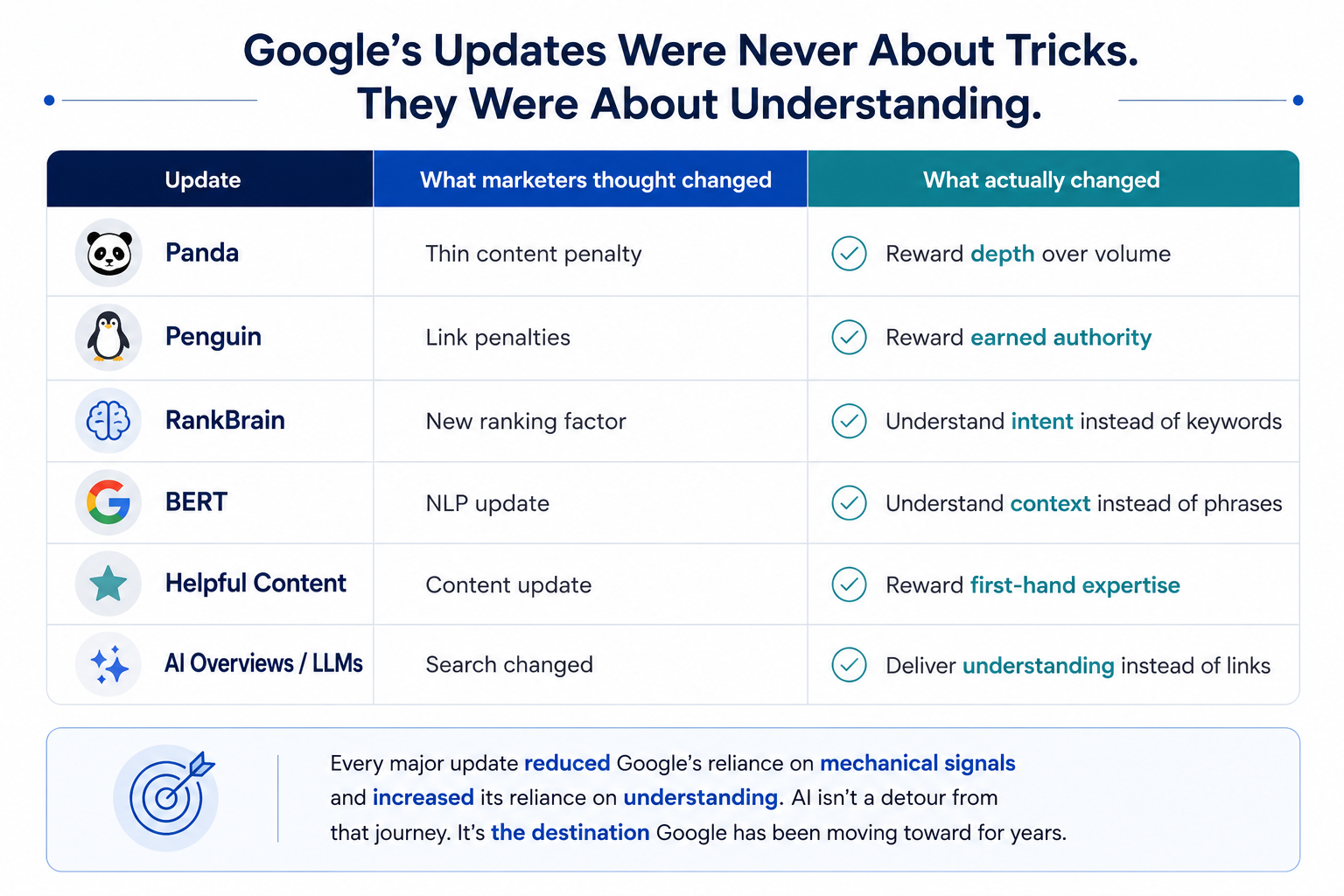
In that sense, AI hasn't really changed what great SEO looks like. It reminded us what SEO is really about.